Wikipedia Started as the Nupedia
A case study in Design from Trust.
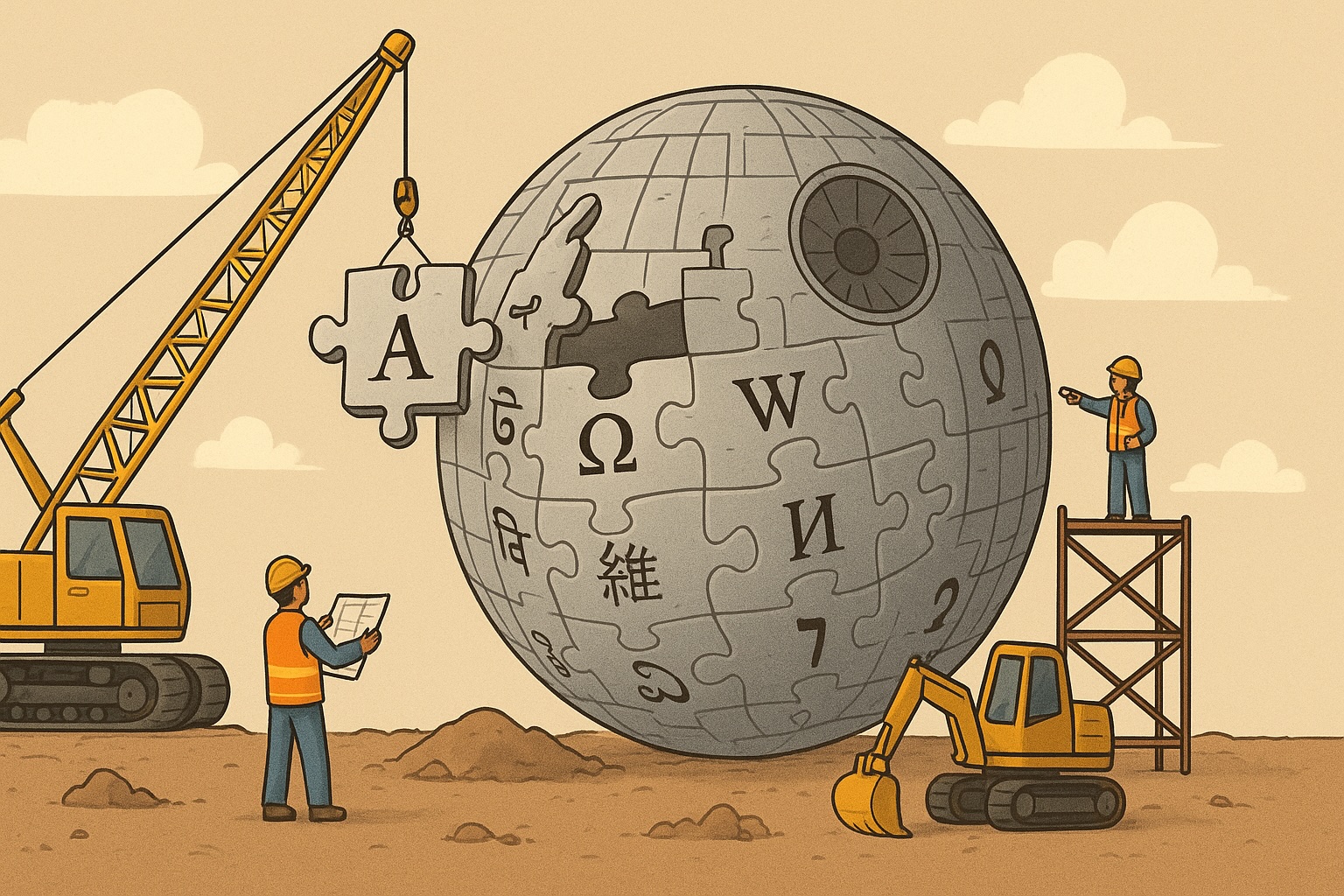
Design from Trust isn't a tweak of existing systems, it's a rethink. Systems that are designed from trust are different enough from the systems they replace to be surprising, sometimes to the point of defying conventional logic and making people squirm. Understanding why these redesigns work and why they initially make us uncomfortable is key to solving the trust crisis we face today. Wikipedia makes a great, familiar example.
Wikipedia wasn't always a Wiki. It started life innocently enough in 2000 as the Nupedia, the brainchild of Jimmy Wales, who wanted to create a free online encyclopedia for the world's benefit.
Jimmy hired Larry Sanger and the two went about the very ambitious project of writing an encyclopedia the way a publisher might: they recruited volunteer editors and assigned them to their domains of expertise (think German, geography, biology, tech, economics, art...). Then they instituted a seven-step editorial process to ensure each article's quality.
Progress was slow. After a year, they had published 21 articles. Production of a whole encyclopedia seemed out of reach.
As the Nupedia crew struggled to birth reliable articles, Wales and Sanger learned about Wikis, which embodied a completely different philosophy about who could be trusted with knowledge creation. The programmer Ward Cunningham had invented Wikis in 1994 (wiki-wiki means "quick" in Hawaiian), so that he and his colleagues would have a quick, HyperCard-inspired way to build websites rich with internal links. (A pioneer of Pattern Languages in software, Ward's first substantial Wiki was the Portland Pattern Repository.)
Anyone? Really?
Wikis embody a radical trust assumption: anyone can edit anything, and the community will self-correct. Several software mechanisms help make this possible. Wikis save every version of every page created, which makes correcting mistakes (or vandalism) straightforward: just revert to the previous saved page. Wikis also allow participants to track changes on pages they care about, so they can see (and possibly revert) changes that matter to them. Contrast this with the CMSes (Content Management Systems) that most publications use, which enforce control through permissions and approval chains, exemplifying architectures of mistrust.
Every Wiki edit is an act of trust: the platform trusts you to contribute, and you trust the community to preserve what's valuable and correct what's wrong. This mutual trust creates something neither traditional publishing nor pure chaos could achieve. Making links between pages in a Wiki is super simple; linking to things on the Web is easy, too. There's no formal editorial process (on Wikipedia, over time, norms emerged, then got codified). There are no titles (like Editor in Chief) or turfs, which encourages open participation.
Notably, you don't have to be qualified to post on a topic to do so. Anyone can. This seems insane, yet it works very well. Wikipedia now contains over 60 million articles in 300+ languages.
Wales told his Nupedia staff they had set up one such Wiki and named it Wikipedia, not expecting much. From that point on, the Wikipedia story became notable online history. Since its launch in 2001, Wikipedia has stayed in or near the top ten most-visited Websites on the planet — and the only one of those that doesn't invade your privacy with cookies and ads.
A question I ask audiences all the time is, "Who has used Wikipedia in the last few months?" Almost every hand in the room goes up. Then I ask the question I'm really after: "Who remembers the moment they figured out how Wikipedia works?" That often elicits chuckles and gasps of recognition, as people flash back to the seemingly out-of-control process I just described.
Not a tweak
The Wiki way is not a tweak of the usual editorial process. In many ways, it's the opposite. Instead of one person assigned to write a piece and another to edit it, then maybe another to approve it, anyone can start or edit any page. Incomplete pages are just as visible as finished ones. And the pages are never quite "done," since they are subject to edits forever.
This openness and sharing of trust creates a sense of shared responsibility that is quite addictive, in the best of ways. Instead of being mere readers or visitors, participants are subtly invited to become contributors, to make the shared asset better for everyone. Only a small percentage of participants take up that invitation, but that turns out to be enough for the system to work well.
Critics predicted Wikipedia would drown in vandalism. Instead, the community's desire to protect quality proved stronger than trolls' desire to destroy it, because people feel ownership of what they're trusted to help create.
What happened with Wikipedia happens whenever we redesign systems from trust. Unfortunately, we don't learn how to Design from Trust in school, so a key task in this series of posts is to help you ID such systems. After that, with some more training, you can build your own, and we'll all benefit.
The Wikipedia story reveals a pattern: when you trust people with meaningful responsibility — even when conventional wisdom says you shouldn't — they often rise to meet it. This is Design from Trust in action.
Some complications:
- When I started using Wikis, I fully expected we would all be collaborating with them now. Alas, Wikipedia "ate" the Wiki space, and we're still sharing separate documents.
- The recent rise of GenAI chatbots that like to give full answers instead of offering links to where the answers live will likely contribute to continued drops in traffic for Wikipedia. Ironically, the Wikipedia corpus has long been an important training element for GenAI.
- Wikipedia's history is not all bright and shiny; you can explore its dark side here.
#Wikipedia #Nupedia #designfromtrust #design
This article is cross-posted on Substack here, Medium here and LinkedIn here. It's also here in my Brain.